

Actualités
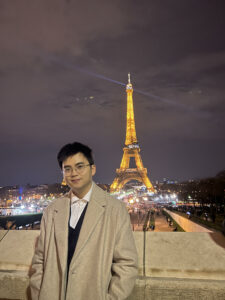
Son Hoang NGUYEN, new CO4SYS PhD student
Welcome to Son Hoang, CO4SYS new PhD student from the 11st of november.
He is supervised by Ionela Prodan.
His office is in D building, 1st floor, D110.
● Can you introduce yourself in a few words?
My name is Son Hoang, but you can call me Sonny. I come from VungTau, which is a beautiful coastal city in the south of Vietnam. I obtained my bachelor program of aeronautical engineering in the University of Science and Technology of Hanoi. Then I came to France and finished the Master degree in Aerospace Engineering with specialization in
Embedded Systems. I am currently take part in the Ph.D research “Robust dynamic planning and control for interacting large-scale multi-agent systems: application to
exploration and containment missions with heterogenous teams of robots”.
● What is your background?
I hold a Master’s degree in Aerospace Engineering with a specialization in Embedded Systems from ISAE-SUPAERO, France, and a Bachelor’s degree in Aeronautical
Engineering from the University of Science and Technology of Hanoi, Vietnam. During my studies, I gained experience working on advanced projects in robotics, control,
and artificial intelligence. I interned as a Flight Dynamics Engineer at Airbus, where I developed deep learning–based estimation models to predict aircraft landing distances
using real-time flight data. I also worked on research projects at ISAE-SUPAERO focusing on obstacle avoidance for autonomous vehicles and robotic development using ROS2 and Gazebo.
Earlier, at the Hanoi University of Science and Technology, I conducted research on nonlinear control and state estimation for UAV systems, leading to two first-author
publications at international conferences.
These experiences have helped me build strong technical foundations in control theory, reinforcement learning, and robotics, as well as practical programming skills in Python,
MATLAB/Simulink, and ROS.
● Can you briefly explain your thesis topic?
My PhD focuses on robust dynamic planning and control for large-scale multi-agent systems, with applications to exploration and containment missions involving heterogeneous teams of robots.
The goal of my research is to develop a flexible and robust architecture that allows multiple autonomous agents—such as ground robots and aerial drones—to cooperate in real time while exploring unknown areas, locating targets, and maintaining containment or surveillance.
I aim to design optimization-based and learning-enhanced algorithms that enable these agents to adapt to uncertainties, faults, and communication constraints while maintaining
coordinated behavior. The work combines control theory, multi-agent systems, and reinforcement learning, with both simulation and experimental validation planned at ONERA
and LCIS laboratories.
● What skills can you share?
I have strong technical expertise in control theory, robotics, and autonomous systems, particularly in designing and implementing control and planning algorithms for multi-agent and robotic platforms. I’m proficient in tools such as Python, MATLAB/Simulink, ROS2, and Gazebo, which I use for simulation, algorithm development, and real-time implementation.
I also have experience with machine learning and reinforcement learning, applying these techniques to improve decision-making and adaptability in autonomous systems.I’m also comfortable working with large datasets, optimizing algorithms, and validating solutions both in simulation and on hardware platforms.
● Where can we find you? How can we contact you?
You can find me at LCIS (Laboratoire de Conception et d’Intégration des Systèmes), UGA, Grenoble INP-UGA, 50 Rue Barthélémy de Laffemas, 26000 Valence, France or
reach me via email at son-hoang.nguyen@lcis.grenoble-inp.fr . I’m always happy to discuss ideas, potential collaborations, or just chat over coffee!
● Would you like to share anything else (an experience, a passion, something personal, etc.)?
Outside the lab, .I am passionate about science, movie, football, music. I believe that creativity, whether in research or daily life, is essential for innovation and personal growth.